Lanka Developers Community

    Lanka Developers

    • Register
    • Login
    • Search
    • Categories
    • Recent
    • Tags
    • Popular
    • Users
    • Groups
    • Shop
    1. Home
    2. priyanka_dutta
    3. Posts
    P
    • Profile
    • Following 0
    • Followers 0
    • Topics 2
    • Posts 2
    • Best 0
    • Controversial 0
    • Groups 0

    Posts made by priyanka_dutta

    • How to Measure Your Voice Frequency Online

      Your voice has a number. Not a note, not a vibe, an actual number in hertz, and you can find it in about two minutes without buying anything. All you need is a mic, a quiet room and a browser.

      Quick background first. Voice frequency is how many times your vocal folds vibrate each second while you talk. A lower number means a deeper voice. Most men speak somewhere near 100 to 130 Hz on an average day and most women closer to 190 to 230 Hz, though honestly there's a lot of overlap and a lot of variety. Your number is just your number.

      Doing the test

      Open Pitchtest.com. It works on a laptop or phone, no app needed. Click allow when your browser asks about the microphone. Skip that and the pitch detector just sits there doing nothing, which confuses more people than you'd think.

      Now talk. Normally. Don't put on a "test voice" because everyone does this and it throws the result off. Read a paragraph out loud, describe your morning, count slowly to twenty, whatever. You'll see the numbers move around quite a bit while you speak, and that's fine. Speech naturally rises and falls. What you're after is where it keeps coming back to.

      Watch for thirty seconds or so and note the range it hovers in. The middle of that range is your average speaking frequency. Some people also like to hum one comfortable, steady note, since a held tone gives a cleaner single reading.

      Getting numbers you can trust

      A few things mess with accuracy. Background hum from an AC or fridge, sitting too far from the mic, whispering. A cold or a late night will pull your voice lower too, so if a reading looks odd, try again another day. Two or three sessions averaged together beats one.

      Why bother at all? Plenty of reasons. Speakers and presenters want to know if nerves push their voice up. Podcasters like to stay consistent between episodes. People doing voice training track small changes over weeks, and a pitch detector shows those shifts long before your ears notice them. Some folks are just curious, which is a perfectly good reason too.
      So give it a go. Open https://pitch-detector.org/, say a few sentences and let the pitch detector give you your number. Takes less time than making tea.
      posted in Artificial Intelligence
      P
      priyanka_dutta
    • How Does Voice Pitch Detection Work?

      94c0b660-25a4-4881-899f-e5107ac0a405-How Does Voice Pitch Detection Work.png

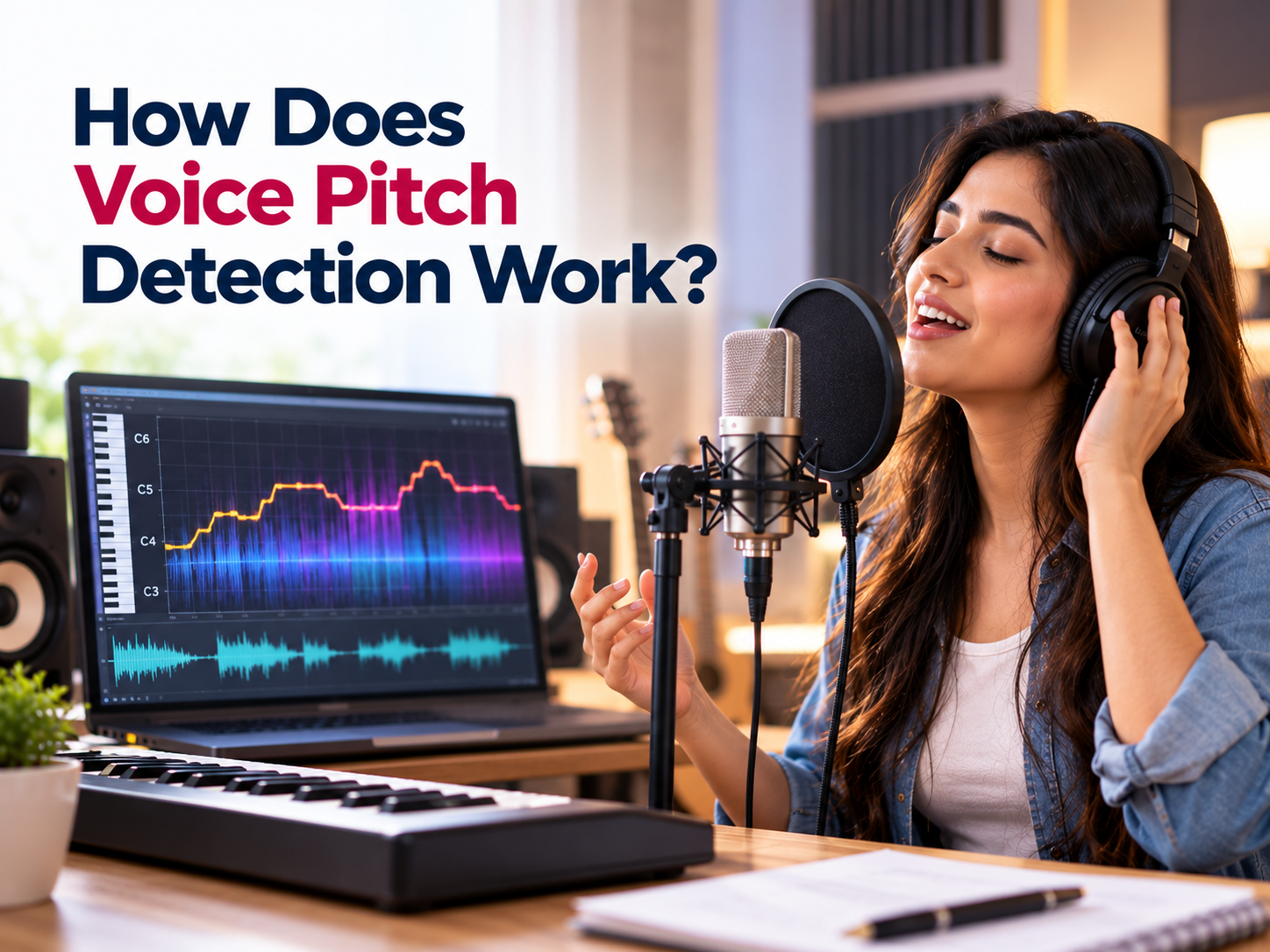
      You sing a note into your laptop and half a second later the screen says G3. Feels a bit like magic the first time. It isn't, and how a pitch detector pulls this off is actually pretty interesting.

      Now, your throat. Inside it sit two small folds of tissue, and when you talk they slap together and apart over and over. Fast. We're talking 100, 150, sometimes 250 times in a single second. Each slap lets a little air through. Since it keeps happening at the same rate, you can count it, and that count per second is the frequency. Hertz, in other words. Your ear just calls it pitch.

      Then your mic gets involved. It cannot hear sound the way you do, so it turns it into numbers instead. Usually 44,100 a second, sometimes 48,000, and every one is a quick freeze-frame of the wave. Picture a messy wiggly line drawn from all those dots. That's what the pitch detector gets handed. Its task is pretty narrow, really: spot how often that wiggle comes back around.

      The clever bit

      A common method is called autocorrelation. Sounds technical. It's not. The software takes a short slice of your voice, makes a copy, and slides that copy along the original bit by bit until the two line up almost perfectly. The distance it had to slide tells it how long one cycle lasts. Flip that around and you get the frequency. Other tools break the sound into its separate frequencies using something called a Fourier transform (FFT, if you've seen the term) and pick out the main one.

      It's not always easy, by the way. A human voice isn't one clean tone. It carries extra layers called harmonics on top of the main note, and sometimes they're louder than the note itself. That's why a cheap pitch detector will occasionally jump a full octave up or down for no clear reason. Better tools double-check for it.

      Last step is turning hertz into a note name. Musicians agree that A4 equals 440 Hz, and every note above or below is a fixed step away, about 6% in frequency per semitone. The software works out the nearest note, and many also show how many cents sharp or flat you are. All of this repeats many times per second, which is why the reading follows your voice live.

      Background noise is the main thing that trips it up. A fan, traffic, a TV in the next room. Quiet space, steady voice, and you'll get clean numbers. Want to see it in action? Open pitch detector website, allow your mic, hum one long note and watch it lock on. Using this free tool, you can easily detect your pitch.

      posted in Artificial Intelligence
      P
      priyanka_dutta
    • 1 / 1